The Reality Today: Fragmented Journeys and Overloaded Agents.
As customer expectations continue to rise, contact centers are under pressure to deliver faster, more accurate, and low-effort experiences. However, for many financial services organizations, the contact center remains one of the most fragmented parts of the customer journey. Customers face long wait times, dropped calls, and slow resolution even for simple requests, while Member Service Representatives (MSRs) manage high volumes with limited automation and minimal real-time support. The challenge is not intent or effortâit is how contact center journeys are designed today.
In most environments, experience breakdowns stem from a set of systemic gaps:
- Long wait times and call drops that drive frustration and repeat attempts
- Manual journeys where routine requests still require live agent involvement
- High MSR workload driven by end-to-end manual steps rather than inefficiency
- Limited automation, forcing agents to search across systems, draft responses, and complete after-call work manually
IVR systems often reinforce these issues. Static menus and shallow intent capture fail to resolve requests early, pushing more interactions into live queues. Customers repeat information, context is lost, and resolution times increaseâeven for straightforward needs. As interaction volumes grow, these inefficiencies compound, consuming skilled agent time on low-complexity tasks and creating delays that feel disproportionate to the request itself.

The Core Problem: Contact Centers Built for Tools, Not Journeys
Most contact centers were built by layering tools over timeâIVR, routing, CRM, workforce systemsâwithout rethinking the end-to-end journey.
The result:
- Customers experience the contact center as a series of disconnected steps
- MSRs carry the burden of stitching those steps together manually
- Operations teams react to volume spikes instead of anticipating them
This model does not scaleâand it places unnecessary strain on both customers and agents.
Rethinking Modernization: Agentforce Across the Contact Center Lifecycle
Modernizing the contact center isnât about optimizing a single system. It requires applying intelligence across the entire lifecycle of an interactionâbefore, during, and after the call.
This is where Agentforce comes in.
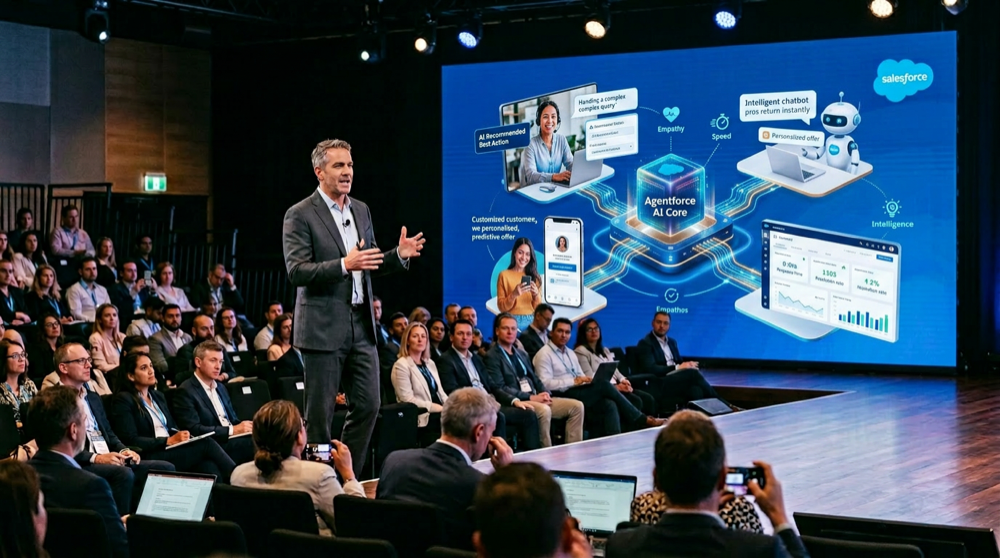
Agentforce enables organizations to embed intelligent, task-aware support directly into contact center journeysâworking alongside MSRs, not replacing them. Instead of relying on static automation or siloed AI features, Agentforce operates across Salesforce data, workflows, and channels to create connected, adaptive experiences.
How Agentforce Supports the Contact CenterâConceptually
A modern contact center can leverage Agentforce in multiple ways, each addressing a specific gap in the journey:
Conversational & Entry-Point Experiences with Agentforce
Agentforce enables natural intent capture and guided self-service at the point of entry, helping resolve simple requests early and reducing unnecessary wait times and transfers.
Intelligent Routing Powered by Agentforce
By using real-time context from Salesforce, Agentforce helps route customers to the right MSR based on skills, language, priority, and historyâreducing misroutes and rework.
Real-Time MSR Support with Agentforce
During live interactions, Agentforce assists MSRs with contextual insights, next-best actions, and automated tasksâhelping agents respond faster and more accurately without switching systems.
Automated Wrap-Up and Summarization via Agentforce
Agentforce can streamline after-call work by generating summaries, updating records, and triggering follow-up actionsâreducing documentation time and cognitive load.
Quality, Sentiment, and Learning with Agentforce
By continuously analyzing interactions, Agentforce helps surface sentiment trends, coaching opportunities, and experience gaps that drive continuous improvement.
Forecasting and Workforce Intelligence Enabled by Agentforce
Agentforce supports operations teams with predictive insights, helping anticipate demand and plan staffing proactively rather than reacting to spikes.
Each of these capabilities addresses a different pain pointâbut together, they begin to repair fragmented journeys.
From Isolated Fixes to a Connected Salesforce Ecosystem
The goal of contact center modernization isnât to perfect IVR, agent assist, or analytics in isolation. Itâs to orchestrate them together on a single platform.
When Agentforce is applied holistically across Salesforce:
- Customers wait less and repeat themselves less
- MSRs resolve issues faster with reduced manual effort
- Operations teams gain real-time visibility and control
The contact center shifts from reactive problem handling to connected journey orchestration.
Conclusion: Building a Foundation for What Comes Next
The Agentforce capabilities outlined here represent a starting pointânot the end state. As organizations mature, Agentforce can extend into proactive engagement, personalization, advanced analytics, and continuous learning.
By rethinking the contact center as an evolving Agentforce-powered ecosystem, organizations move away from fragmented, tool-driven models and toward experiences that are consistent, scalable, and human-centered.
This foundation makes it possible to go deeperâthrough focused case studies, implementations, and measurable outcomesâwithout losing sight of the bigger picture.
Enjoyed this insight?
Subscribe to our newsletter to receive the latest perspectives on AI and digital transformation directly in your inbox.